
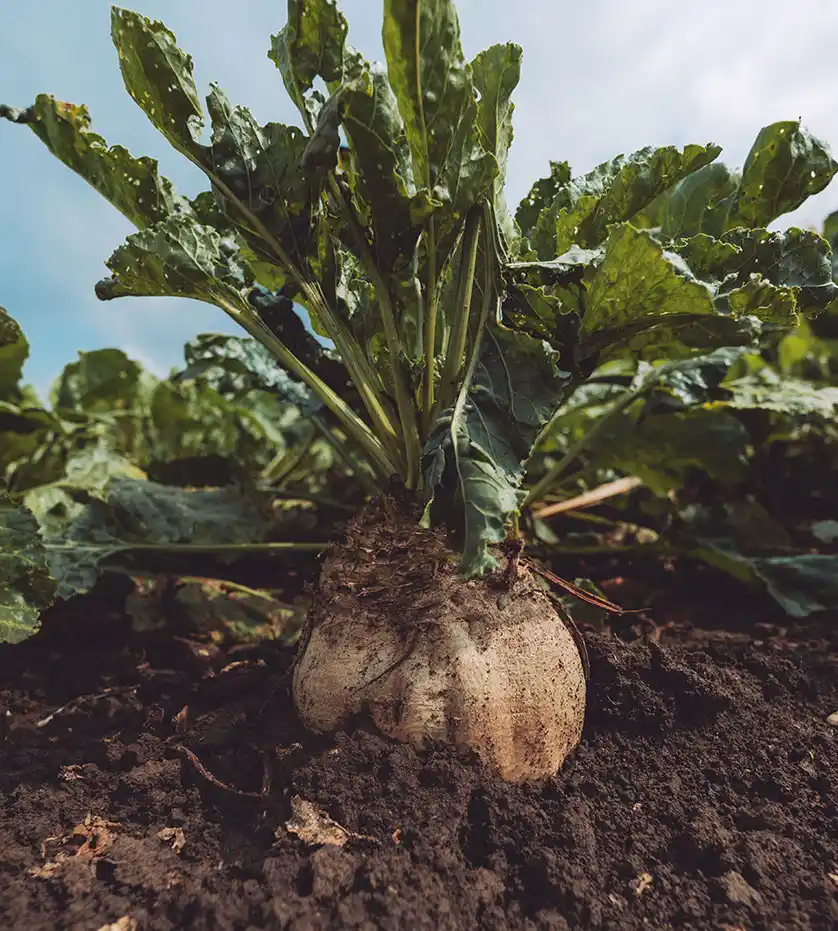
Soil Preparation for Sugar Beet Production
Sugar beet cultivation in our country is not only the main source of livelihood for approximately 500 thousand farmers, that is about 3 million people, but is also closely linked with agriculture, livestock (feed, medicine, meat, milk), transport and service sectors. Therefore, the subject forms an integrated structure that simultaneously involves many fields such as agriculture, agro-industry, processed basic food production and employment. In sugar beet, not only high yield but also quality is extremely important, since the product price is determined according to the sugar content in the beet. In order to achieve both high yield and high quality, the farmer must know very well which operation should be done, when and how, at all stages such as soil preparation, fertilization, sowing, crop care, pest and disease control, irrigation, harvest and storage in clamps (silage heaps).
SOIL PREPARATION
In sugar beet production, the basis of soil preparation is autumn ploughing and it must definitely be carried out. In fields ploughed in autumn, it is possible to benefit from autumn and winter precipitation to the maximum extent, and in spring, field preparation and seedbed formation can be completed more easily and in a shorter time. If autumn ploughing is not done and the field is ploughed in spring, the field is entered frequently until sowing time. This leads to loss of time, loss of soil moisture and structure (tilth) and, consequently, delay in sowing. Spring soil preparation is one of the most critical operations in sugar beet farming. The timing of tillage before sowing and the proper use of equipment have a significant effect on yield, quality and thus total production. Ploughing the fields at the same depth for many years causes the formation of a hard “plough pan” layer at the bottom. This layer prevents beet roots from penetrating deeper and causes root forking. For this reason, it should not be forgotten that this layer must be broken every 4–5 years by using a subsoiler (ripper) at a depth of 50–60 cm.
VARIETY SELECTION
When choosing a sugar beet variety, the following characteristics must be taken into account.
- The variety to be sown must be suitable for the local climate and soil conditions,
- It should be resistant to diseases and have good tolerance against bolting (premature seeding),
- It should have high root yield and sugar content,
- The seed should have good germination power and strong, uniform field emergence,
- It should be healthy, reliable, certified and economical.
SOWING
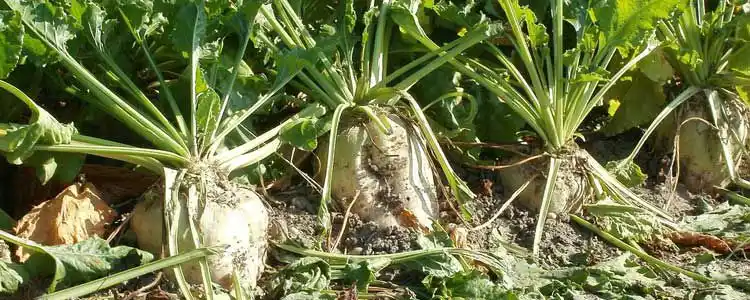
In sugar beet, sowing time is a decisive factor for both root yield and refined sugar content. If sowing is delayed, the growing period of the plant becomes shorter, it has difficulty reaching full maturity and the expected benefit from applied fertilizers cannot be obtained. At the same time, the resistance of plants to diseases and pests decreases. For this reason, it is extremely important that sugar beet is sown in the period that is suitable for the region.
Once spring soil cultivation and seedbed preparation are completed, sowing should be carried out without delay, before soil moisture and tilth are lost.
According to long-term averages in the Konya Region, spring frosts may occur until mid-April.
Being overly cautious about the risk of re-sowing caused by late spring frosts and therefore delaying sowing too much can often result in loss rather than profit. Therefore, the most correct approach is to perform sowing when soil temperature and climatic conditions reach suitable levels. Sugar beet seeds are able to germinate and emerge to the soil surface even at soil temperatures of 4–5 °C.
The most suitable starting time for sowing is the period when the soil temperature at 0–5 cm depth regularly reaches 5–7 °C and, depending on rainfall, the soil surface becomes suitable for harrowing; in other words, when ideal soil tilth is achieved. In Central Anatolia and transition regions, the most appropriate sowing window is generally from the end of March to mid-April. For the Konya region, sowing of sugar beet is recommended to start from 15 March onwards, depending on soil moisture conditions. To reduce seed loss and thinning labour, the in-row spacing should be adjusted according to soil fertility and soil moisture status. When sowing is done under proper soil tilth, it becomes easier to achieve the target plant population.
Sugar beet should be grown on the same field only once every four years within a four-year crop rotation system. If there is a high weed population in the field, an appropriate herbicide must be applied before or immediately after sowing. If weed control is neglected, young beet seedlings may be choked after emergence, their development is restricted and yield is significantly reduced. In our country, sugar beet is usually sown with 45 cm row spacing and plants are thinned to 20–25 cm on the row. Trials have shown that a plant density of 9,000–10,000 plants per decare gives the best results. However, to secure emergence, many growers sow too densely on the row, which increases seed costs. Sowing speed is also an important factor affecting sowing quality. In sowing with precision drills, the speed of the tractor pulling the drill should not exceed 4 km/h. Excessive speed causes non-uniform seed distribution, disruption of sowing depth and some seeds remaining on the soil surface.
IRRIGATION WATER REQUIREMENT OF SUGAR BEET AND IRRIGATION SCHEDULING
Crop water use is defined as the total amount of water lost during the growing season through evaporation from the soil and transpiration from plants. The crop water use values of sugar beet given in Table 1 are about 777 mm under Konya conditions.
Table 1. Sugar Beet Crop Water Use Values
|
MONTHS |
Crop Water Use (mm) |
Average Precipitation (mm) |
Irrigation Water Requirement (mm) |
|
APRIL |
40.0 |
42.4 |
- |
|
MAY |
105.0 |
42.7 |
62.3 |
|
JUNE |
150.0 |
31.2 |
139.5 |
|
JULY |
207.0 |
10.5 |
196.5 |
|
AUGUST |
185.0 |
9.1 |
175.9 |
|
SEPTEMBER |
82.0 |
13.4 |
68.6 |
|
TOTAL |
769.0 |
149.3 |
619.7 |
EMITTER SPACING AND DISCHARGE
In drip irrigation systems used on row crops, the spacing between lateral lines (drip lines) is determined according to the soil infiltration rate and emitter discharge. In sugar beet, row spacing is 45 cm and in-row spacing is about 22–25 cm. In practice, it is recommended to lay the lateral lines at 90 cm intervals. In this way, one lateral line irrigates two rows.
Using the equation Sd = 0.9√(q/l), the emitter spacing (Sd) is calculated according to the soil infiltration rate (I) and emitter discharge (q). The recommended emitter spacings based on these calculations are given in Table 2.
Table 2 : Emitter Spacing (cm) According to Infiltration Rate and Emitter Discharge
|
Discharge l/h |
Soil Infiltration Rate (mm/h) |
|||||||||||
|
5 |
10 |
15 |
20 |
25 |
30 |
35 |
40 |
45 |
50 |
55 |
60 |
|
|
1.6 |
51 |
36 |
29 |
25 |
23 |
21 |
19 |
16 |
17 |
16 |
16 |
15 |
|
2.2 |
57 |
40 |
33 |
28 |
25 |
23 |
22 |
20 |
19 |
18 |
17 |
16 |
|
2.6 |
66 |
46 |
37 |
32 |
29 |
26 |
26 |
23 |
22 |
21 |
20 |
19 |
MAXIMUM LENGTH OF DRIP LINES
The maximum extension (length) of drip lines depends on pipe diameter, emitter discharge, emitter spacing, whether the emitters are pressure-compensating and the operating pressure of the system. For 17 mm non-pressure-compensating drip lines, the maximum lateral lengths calculated for 5–15% flow variation are given in Table 3.
Table 3: Maximum Lateral Lengths (m) of Non-Pressure-Compensating Flat 17 mm Drip Lines at Different Flow Variations, Discharges and Emitter Spacings
|
Flow Variation % |
Emitter Spacing (cm) and Discharge (L/h) |
|||||||
|
25 cm |
30 cm |
40 cm |
50 cm |
|||||
|
1.6 |
2.6 |
1.6 |
2.6 |
1.6 |
2.6 |
1.6 |
2.6 |
|
|
5.0 |
104 |
72 |
118 |
80 |
153 |
106 |
164 |
119 |
|
7.5 |
116 |
81 |
130 |
89 |
170 |
118 |
185 |
134 |
|
10.0 |
124 |
85 |
140 |
94 |
182 |
124 |
198 |
141 |
|
15.0 |
137 |
91 |
155 |
102 |
200 |
137 |
220 |
156 |
PLACEMENT AND REMOVAL OF LATERAL LINES IN THE FIELD
In sugar beet cultivation, drip lines should generally be laid in the field after the second hoeing operation is completed. The system is usually removed from the field in the 3rd or 4th week of September, before harvest.
EFFECTIVE ROOT DEPTH AND IRRIGATION INTERVAL
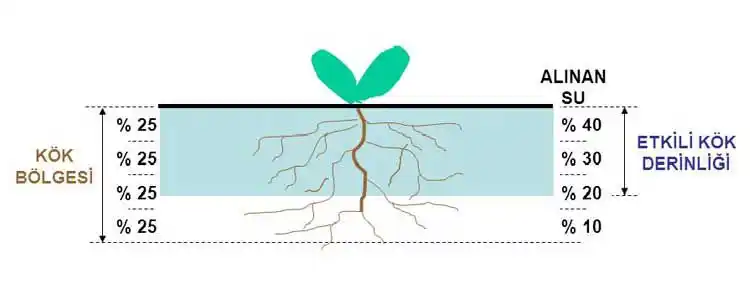
In sugar beet, the effective root depth is about 90 cm, and most of the fine roots are concentrated in the upper 0–60 cm layer. Therefore, in drip irrigation scheduling, an effective root depth of 60 cm is taken into consideration. Irrigation should be applied again when 40–50% of the available water stored at field capacity is depleted. During the growing season, when daily crop water use exceeds 5 mm, the irrigation duration should be reduced by 20% in heavy-textured soils and by 30% in light-textured soils for each 10 mm of effective rainfall. If 50 mm or more rainfall occurs between two irrigations in heavy-textured soils, and 35 mm or more in light-textured soils, irrigation should be postponed or omitted.
PLANT NUTRIENT REQUIREMENTS
For sugar beet with a target yield of 10–12 tons per decare, the required plant nutrient amounts are given in Table 4; the basal fertilization program recommended at sowing, based on soil analysis results, is shown in Table 5, and the program suitable for application via drip irrigation is given in Table 6.
Table 4: Plant Nutrient Requirements of Sugar Beet (kg/da)
|
N |
P2O5 |
K2O |
MgO |
S |
|
18–24 |
8–10 |
34–36 |
2–3 |
4–5 |
Table 5: Basal Fertilization Program for Sugar Beet at Sowing, According to Soil Analysis
|
Phosphorus in Soil (P2O5 ) kg/da |
Recommended Fertilizer Type |
Fertilizer Rate (kg/da) |
|
1 or less |
DAP (18-46-0) |
16–18 |
|
2–3 |
DAP (18-46-0) |
13–11 |
|
Compound (20-20-0) |
30–25 |
|
|
Compound (15-15-15) |
40–35 |
|
|
4–5 |
Compound (20-20-0) |
20–15 |
|
Compound (20-20-0) |
25–20 |
|
|
6–7 |
Compound (20-20-0) |
10–5 |
|
Compound (20-20-0) |
13–7 |
|
|
8 or more |
Ammonium Sulphate (21% N) |
12–14 |
|
Ammonium Sulphate (26% N) |
10–11 |
|
|
Ammonium Sulphate (33% N) |
7–9 |
Table 6: Fertilization Program for Sugar Beet Applied via Drip Irrigation
|
Plant Nutrient and Rate |
Fertilizer Type |
Medium and Heavy-Textured Soils |
Light-Textured Soils |
||
|
Rate (kg/da) |
Number of Applications |
Rate (kg/da) |
Number of Applications |
||
|
Nitrogen (20–24 kg/da) |
Ammonium Sulphate (21% N) |
10.0 |
8–10 |
6.5 |
12–14 |
|
Ammonium Sulphate (26% N) |
8.0 |
8–10 |
5.0 |
12–14 |
|
|
Ammonium Sulphate (33% N) |
6.0 |
8–10 |
4.0 |
12–14 |
|
|
Urea (46% N) |
4.0 |
8–10 |
3.0 |
12–14 |
|
|
Potassium (6–8 kg/da) |
Potassium Nitrate |
2.0 |
6 |
1.5 |
8 |
|
Potassium Sulphate |
2.0 |
6 |
1.5 |
8 |
|
|
Magnesium (2–3 kg/da ) Sulphur (4–5 kg/da) |
Magnesium Sulphate (16% MgO + 32% SO3) |
2.0 |
6 |
1.5 |
8 |
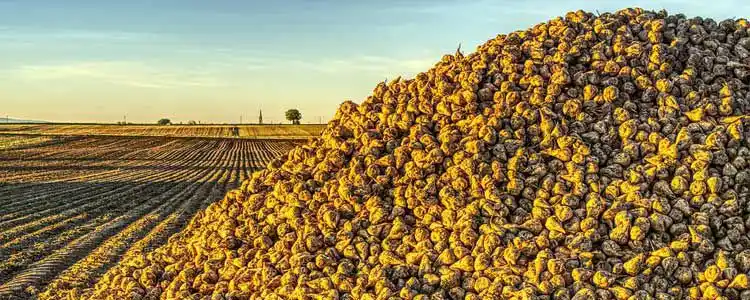
Before sowing, applying 4–6 tons of farmyard manure, 2–3 tons of poultry manure or about 2 tons of compost per decare increases organic matter, provides a source of both macro- and micro-nutrients, boosts yield and improves the physical structure of the soil.
In chemical fertilization, only one of the fertilizers listed in Tables 5 and 6 should be chosen; fertilization should be completed about 1 month before harvest and irrigation should be stopped 15 days before harvest.