
Potato Planting
FIELD PREPARATION
- Soil structure and characteristics of the previous crop determine the cultivation process for potatoes. Well-prepared soil is essential for rapid sprouting, strong root growth and quality tuber formation.
- In heavy clay soils prone to compaction, main plowing is performed at 20–25 cm depth in autumn. In spring, the seedbed is finalized using disc harrowing and leveling harrows without excessive soil fragmentation.
- In light sandy soils with high water infiltration and rich in organic matter, shallow plowing is applied in spring while avoiding over-loosening. Generally, only harrowing is enough for seedbed preparation.
CROP ROTATION
Continuous potato planting on the same land increases soil-borne diseases and reduces production performance. Legumes that enrich nitrogen, grains and winter cereals are ideal rotation crops.
SEED TUBER QUALITY AND SELECTION
The planting material in potato production consists of the tuber itself. For efficient development, tubers should be about 6 cm in diameter and 45–55 grams in weight. The right variety must be selected based on production purpose (table, industrial or seed). Certified seed material should be preferred when possible. At planting, tuber eyes must be active, and short greenish chlorophyll sprouts of about 1 cm should be present on the surface.
PLANTING
- Potatoes are planted in spring when soil temperature reaches 8–10 °C and frost risk has passed.
- Planting season in the Black Sea region generally covers February and March.
Row spacing is planned at 70–75 cm and within-row spacing at 20–40 cm. Planting depth is around 2 cm for shallow planting and 4–6 cm as the standard depth. After planting, ridges are formed by adding at least 15 cm of soil on shallow planting and 10 cm on deeper planting. Timing of ridge formation:
- If cold temperatures or soil crusting occur after planting, ridge formation is postponed until sprouting is completed.
- If hot and dry conditions are expected, ridges are formed right after planting. The process can be done by hand or machines. The most efficient planting method includes:
- 1. Placing seed tubers evenly at the base of the furrows opened by a ridge plow,
- 2. Closing the furrows by running the same plow over the ridges.
- Hilling and mechanical weed control can also be done with the furrow plow once plants reach suitable size after sprouting.
- Tuber requirement per decare is 200–250 kg in irrigated farming and 140–160 kg in dry farming conditions.
CROP CARE
Before sprouts emerge, harrowing the soil surface using adjusted harrows that do not harm plants helps break the soil crust and suppress newly emerging weeds.
First hoeing is applied carefully when potatoes have 3–4 leaves, not exceeding 2–3 cm of depth. This aerates the soil, weakens weeds and helps maintain moisture. During the growth period, hoeing and hilling are repeated 3–4 times at 20-day intervals if necessary.
FERTILIZATION
Potatoes adapt very well to farm manure. Applying 1.5–2 tons of well-decomposed farm manure per decare significantly improves yield. In very poor soils, the amount can go up to 2.5 tons, but exceeding this level may reduce starch content and negatively affect flavor.
The best fertilization program is based on soil analysis. If analysis is not available, 14–16 kg N, 8–10 kg P, 8–10 kg K per decare can be applied under irrigated conditions. All phosphorus and potassium and half of nitrogen must be band-applied at planting. The remaining nitrogen is incorporated into the soil before the first irrigation and hilling. For combined potato planters, fertilizers should be applied simultaneously with the seed in bands.
IRRIGATION
Water deficiency in potatoes is observed through wilting, light color and yellowing starting from the lower leaves. Considering soil moisture, the first irrigation begins when tubers reach hazelnut or walnut size. Irrigation intervals are 15–18 days for light soils and 22–25 days for heavy soils, for a total of 2–4 irrigations. A 7-day period should be left between the last irrigation and harvest.
- The most common irrigation system is furrow irrigation. Furrow spacing is 60–65 cm for sandy soils and 70–80 cm for clay-rich soils.
- The most critical water demand period for potatoes starts 15–25 days before flowering and continues until the end of tuber setting.
- Insufficient or irregular irrigation causes yield loss, deformation, internal darkening, cracks and hollow formation in tubers.
HARVEST
Harvest maturity is recognized by complete drying of the above-ground parts, easy separation of tubers from the stem and hardening of the skin. Mature tuber skin cannot be peeled easily by a fingernail and the inside section shows a dark matte dense texture.
During harvest and lifting, tubers must not be damaged mechanically or by hand and all products should be collected without being left in the field. Soil should not be muddy or overly wet, it must be in suitable moisture conditions (field temper).
Different harvesting options include:
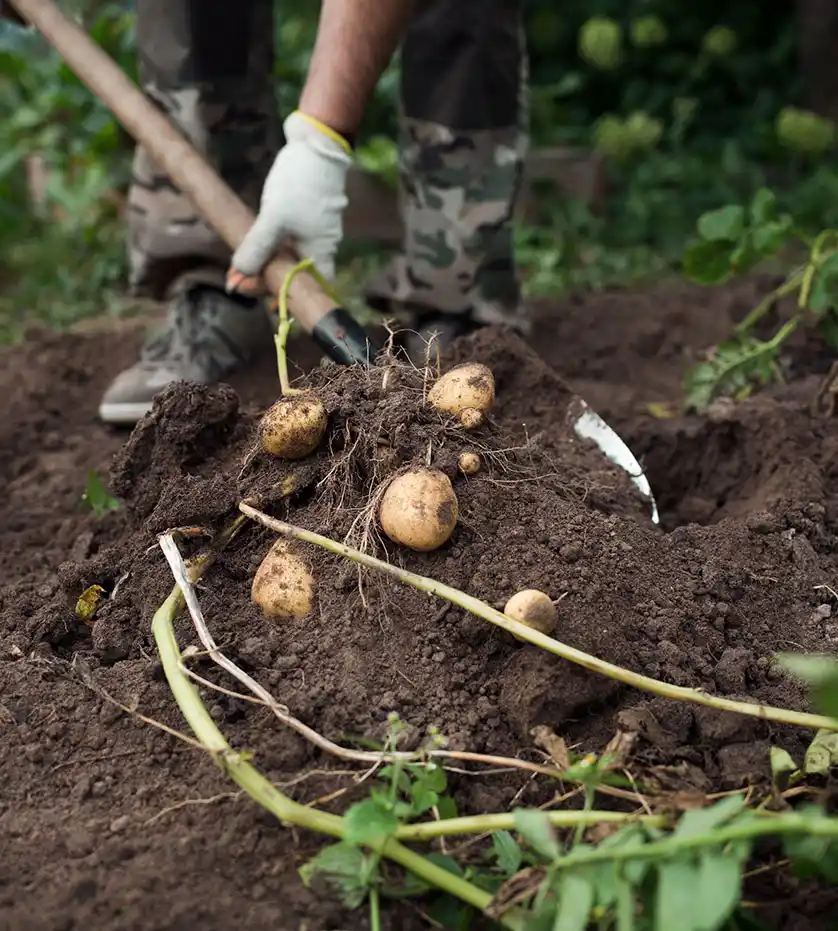
- Lifting potatoes using a hoe, spade or fork and collecting by hand.
- Lifting using a plow and separating tubers from the potato haulm manually.
Single or double row harvesters may also be preferred depending on land size and conditions.
If tubers are wet after lifting, they should be dried in the shade without direct sun. Diseased, rotten, skinned or bruised ones are removed. Afterwards tubers are graded (large, medium, small) and placed into mesh sacks.
STORAGE
Improper storage results in high waste due to the potato’s high water content. If conditions are not suitable, tubers may shrink, rot or sprout early, reducing market value.
The best storage conditions are 3–4 °C temperature, 85–90% relative humidity and continuous airflow to maintain oxygen circulation. Heap height may reach 3–4 m for table potatoes but should not exceed 1 m for seed tubers.
REFERENCES
Ahmet ERAKMAN Agricultural Engineer - SAMSUN